Phone storage is full or the user does not want another app
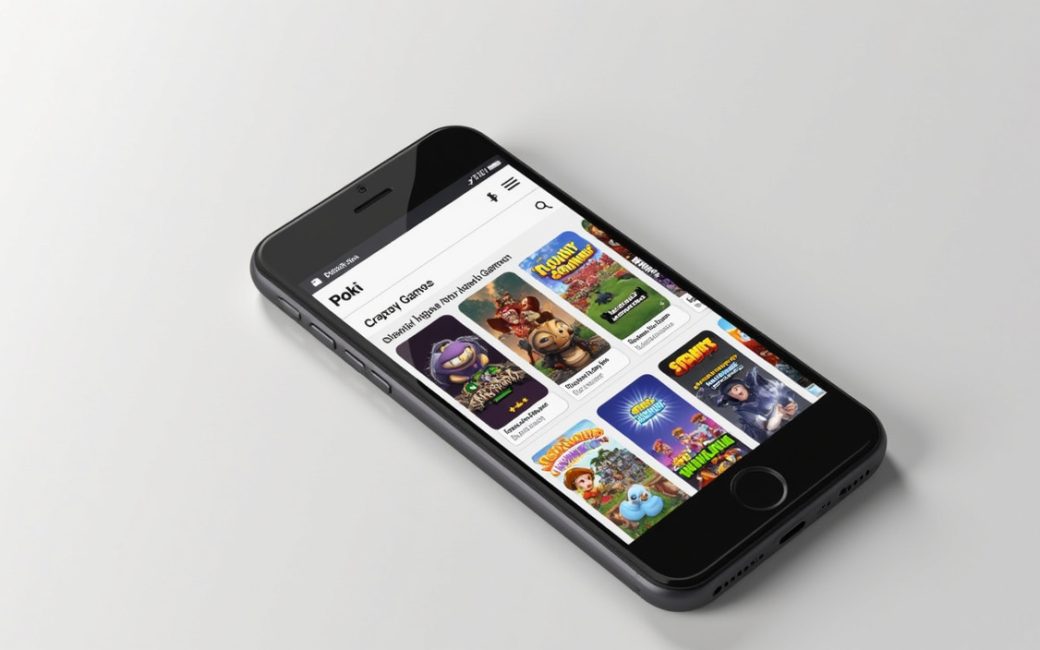
When there's no room for another install on an Android phone or an iPhone, or no interest in adding one, the fastest route to actual play is a browser. Portals like Poki and CrazyGames load games directly in the phone's browser, with no download and no account required. Tap a title, wait for it to load over the mobile connection, and play — the game runs as a webpage, not an installed app, so there's nothing to delete afterward and nothing taking up space beforehand.
This matters because the constraint isn't really "which game is best" — it's "which game can I start in the next thirty seconds." Installed app games, whether from the Google Play Store on Android or the App Store on iPhone, cannot be added if storage is full or the user simply doesn't want the commitment of an install. Browser-based instant play sidesteps that entirely: the title runs inside the browser itself, not through Google Play Games or any store's launcher, so it never appears in an installed-apps list and never needs tracking or updating. The tradeoff is that these titles tend to be shorter, simpler puzzle and arcade games rather than the large 3D titles that dominate app-store charts — a fair swap when the goal is filling five minutes, not building a library.
Habitual doomscrolling fills idle minutes
The fix isn't necessarily less screen time, it's bounded screen time. An open feed — social media, video shorts, anything with infinite scroll — has no natural stopping point, which is exactly why it eats more time than intended. A level-based puzzle or racing game has a defined start and a defined end: you finish the level, or you don't, and either way the session closes itself.
This is a useful filter when choosing what to open instead of a feed:
- Puzzle games with discrete levels (match-three, block-fitting, word puzzles) give a natural stopping point after each round.
- Racing games with lap or track limits end automatically rather than looping indefinitely.
- Anything with an infinite or endless mode defeats the purpose — it behaves like the feed it's meant to replace.
Sites built around exactly this kind of short, self-contained session — Cool Math Games is one long-running example — work well here precisely because each puzzle has a clear finish line, unlike a scroll that never really ends. These, too, are usually played as browser-based instant play rather than installed apps, which keeps the "one round, then stop" habit easy to repeat without opening a store first.
User asks which mobile game is actually best
"Best" splits into two different questions, and most lists answer only one without saying so. One is: which game has the most people currently playing it. The other is: which game reviewers and players rate highest in quality. These produce different, sometimes contradictory, top-10 lists, and neither is wrong — they're measuring different things.
| Ranking type | What it measures | Best suited to |
|---|---|---|
| Most-played / popularity | Concurrent or total player count | Multiplayer titles, playing with friends, finding an active community |
| Highest-rated / critic score | Review scores, aggregate ratings | Solo play, judging polish and design quality |
| Best-selling | Units sold or revenue over time | Long-term franchise strength, not necessarily what's active today |
Platform charts like Steam's most-played list and Xbox's popular games browse page are built on live player-count data, which is why they shift week to week. A historical sales ranking, such as the list of best-selling video games, answers a completely different question — what sold the most copies over a game's lifetime, not what's being played right now. On Android, Google Play Games can surface a personal view of this — it lists, launches, and tracks achievements for installed titles on the device — but that's a record of what one person plays, not a popularity ranking of what's played most widely. Deciding which kind of "popular" you actually want narrows the list before you even look at titles.
A game is advertised as free
"Free" on a store listing rarely means the game costs nothing to actually play through. Most free mobile games make money through ad breaks between sessions, rewarded-video ads for bonus currency, or in-app purchases that speed up progress the game otherwise slows down deliberately. None of that is disclosed in the word "free" itself — it shows up further down the store page, in the in-app purchase price ranges and the ad flag, whether that page is the Google Play Store on Android or the App Store on iPhone.
Before installing, checking the store listing for a few specifics avoids surprises later:
- Whether the listing shows an in-app purchase price range, which signals a spending ceiling built into progression.
- Whether ads are flagged as present, and whether they appear between levels or only on request (rewarded ads).
- Whether progress in a level-based game slows sharply at a certain point — a common sign of a paywall disguised as difficulty.
A genuinely free game, an ad-supported one, and a free-to-start game with a paywall further in are three different products wearing the same label. Reading past the install button, rather than the app icon, is the only way to tell which one you're getting — and if none of that appeals, browser-based instant play at a portal like Poki skips the store listing altogether, since there's no install and no in-app purchase screen to check.
Where this leaves the "top 10" question
There isn't one authoritative top-10 list, because "popular" branches into player-count charts, sales history, and critic scores that don't move together. What's more useful than memorizing a ranking is knowing which type of list answers the question you actually have, and which channel it applies to — an Android chart, an iPhone chart, or a browser portal with no platform at all. Then check a live source for it, since these charts change often enough that a static top-10 written today won't match next month's numbers. Pick the axis — most-played, best-selling, or highest-rated — and the platform, before picking the game.